Montro

Episode

When Controls Meet Reality

A framework that reads well for auditors can still fail when pressure hits. In this episode of Montro In Practice, Ankur Arora sits down with Emmanuel Ranchin, VP of Information Protection Governance at State Street, on the gap between documented controls and lived ones: why compliant isn't the same as resilient, how big institutions break where silos meet, and what DORA really asks of the board.

Published

25 September 2026

Duration

39 minutes

Guest

About the speaker

Emmanuel Ranchin is VP of Information Security Governance at State Street, where he leads a function that joins up technology, risk and resilience across the bank. He came to security and operational risk by an unusual route - chemical engineering, then two decades of finance transformation across global institutions including Citi, RBS, Aviva and Novartis.


That crossing of fields is the thread of this conversation: what someone who has watched processes fail in a chemical plant and a trading floor can see about risk that a career specialist might miss.

Episode guest

In this episode

A risk register can look immaculate. Every policy signed off, every control attested, every committee minuted, and none of it tells you what happens when something actually goes wrong. Emmanuel Ranchin has spent a career in the gap between the two: the framework on paper, and the way it holds (or doesn't) when the pressure comes on. This conversation lives in that gap.


The document is a snapshot. The risk keeps moving.


Emmanuel's first point is that an attestation is a moment frozen in time. You test your resilience, you refresh the paperwork - and then, too often, it goes into a shared folder nobody opens again. Meanwhile the business changes, the vendors change, the threats change, and the document quietly drifts out of step with reality.


"Just because you've completed your resilience testing or your attestation refresh doesn't mean you pack that into a filing cabinet and never visit it again. It has to be accurate, current, and always challenged." - Emmanuel Ranchin


The real test, he says, isn't whether you can describe your framework to a regulator. It's whether the organisation can keep going when a risk event hits - whether processes bend, adapt and still deliver, rather than snapping.


Compliance can breed a dangerous kind of comfort


There's a version of "we're compliant" that's actually a risk in itself. Emmanuel has seen teams manage their compliance evidence beautifully, walk into a regulator's office as best in class, and then stop looking. The paper says everything is fine, so the search for the thing you haven't thought of quietly ends.


That, he argues, is where resilience and compliance part ways. Compliance asks: have we met the requirement? Resilience asks a harder question: it will happen, so how do we recover? The frameworks still matter, they're the map you reach for when the fog comes down and you've lost the landscape. But a map is not the same as knowing you'll make it home.


Where big institutions really break


Ask Emmanuel where large organisations fail and he doesn't point at technology. He points at the handoffs. Finance does its thing, HR does its thing, security does its thing - and at the seams between them, where one team's work becomes another's, nobody quite owns the flow. Every handoff is a point of fragility. Miss one, and finance doesn't process a salary run, and suddenly everyone is pointing fingers across the silos.


His fix isn't a new control. It's getting people in a room, mapping how the work actually moves, and letting the conversation itself start to dissolve the walls. Innovation, as he puts it, happens at the interface, the place where two worlds meet and someone is willing to understand both sides. It's the same instinct that let a chemical engineer read a bank's broken account-opening process and see, underneath it, the same failure modes he'd seen in a plant.


The risk was never really the framework. It's everything the framework stops you from looking at once you've decided it's done.

More

More from the series

Worth your time – security, privacy, and resilience leaders across Europe.

Compliant on Paper Isn't Compliant in RealityGDPR, EU AI Act, Privacy Engineering, AI Governance, Data Protec
TueSept 2026

Compliant on Paper Isn't Compliant in Reality

A policy can say all the right things and still not describe what's actually running. In this episode of Montro In Practice, Ankur Arora sits down with Abhishek Bansiwal - DPO, lawyer, and privacy-and-AI governance leader, on the gap between paper compliance and lived reality: why "anonymised" often isn't, why the AI Act is closer to a product safety law than a privacy one, and the one question every leader should start asking - "so what?"

Watch now
Why Compliance Isn't SecurityCybersecurity, NIS2, Third-Party Risk, Multi-Cloud, Compliance
MonAug 2026

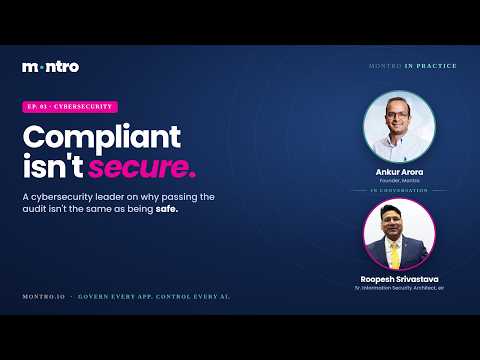
Why Compliance Isn't Security

"Compliant" and "secure" are not the same thing. In this episode of Montro In Practice, Ankur Arora sits down with Roopesh Srivastava, a cyber and resilience leader with two decades across military and enterprise, on why tick-box compliance leaves you exposed: people as the weakest link, building security into multi-cloud without slowing the business, getting third-party risk under control, and what NIS2 really asks of you.

Watch now
Why People Break the Rules Around AI at WorkShadow AI, Behavioural Science, AI Adoption, Human Behaviour
MonAug 2026

Why People Break the Rules Around AI at Work

Rules on paper rarely survive contact with people. In episode two of Montro In Practice, Ankur Arora sits down with behavioural scientist David DeFranza on why employees reach for AI tools they're not meant to use: the gap between personal productivity and organisational risk, why we behave more rationally when we think we're dealing with AI, and where that quietly becomes dangerous.

Watch now
View all

Don't miss the next conversation

Get new Expert Series episodes and governance insights in your inbox.

Browse episodes