
Scope
Who must comply?
Essential entities in energy, transport, water, health, and digital infrastructure sectors.

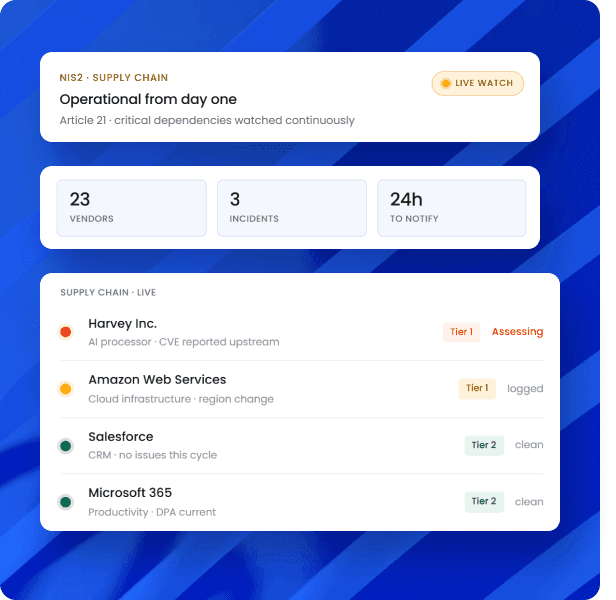
NIS2 enforcement is no longer a future concern—it is here. Essential entities across energy, transport, water, health, and digital infrastructure must now demonstrate continuous compliance, board-level governance, and supply chain risk management. Most organisations discover their true exposure only when regulators ask the hard questions.
Montro changes that equation. We automatically discover every SaaS application and AI tool in your organisation—including shadow IT that spreadsheets and manual audits miss—then classify each one against NIS2 articles and supply chain obligations. The result is an audit-ready compliance register that evolves in real time as your technology estate changes.
You do not need to choose between operational agility and regulatory certainty. Montro gives you both. Our EU-native platform stores all data in Dublin and operates without US cloud dependencies, meaning your compliance evidence stays within European jurisdiction and your team retains full visibility.
The organisations that win under NIS2 are those that treat compliance as a continuous operational practice, not a once-yearly checkbox. That is what Montro enables—systematic discovery, classification, and monitoring that satisfies board reporting requirements and regulators alike.
Start with a 30-day AI Discovery Audit. See exactly what you are running, where the gaps are, and what your compliance posture actually looks like.
Regulatory
NIS2 is not a single compliance checkbox. It is a framework that reshapes how essential and important entities manage digital risk.
Scope
Essential entities in energy, transport, water, health, and digital infrastructure sectors.
Obligations
Risk assessments, incident reporting within 24 hours, supply chain management, and board-level governance.

Enforcement
Automatic discovery and classification of all SaaS and AI tools against NIS2 requirements.

Operational
Automatic discovery maps every SaaS and AI tool against NIS2 articles

Discovery
Uncover every SaaS app and AI system across your organisation

Classification
Classify each application against NIS2 articles and supply chain obligations

Monitoring
Maintain an audit-ready register that evolves with your SaaS estate
Liability
NIS2 allows national law to hold management personally accountable when cybersecurity duties are breached. For CISOs, that makes demonstrable visibility into digital supply chains and incidents a career-defining requirement—not a paperwork exercise.
Montro is built to give security leaders continuous evidence of what is connected, what changed, and how it maps to regulatory expectations—so you are not relying on quarterly spreadsheets when scrutiny arrives.

European
Montro runs on EU infrastructure and answers to European data protection law. Your compliance register stays in Europe — built by people who understand how the DPC, BaFin, CNIL, and ICO actually enforce these rules.
All data is stored in the EU. No US cloud. No data transfers. Full compliance with GDPR and the EU AI Act.
Designed by people who understand how the DPC, BaFin, CNIL, and ICO actually work. Not a US platform retrofitted for Europe.
In 30 days. For free. No credit card. No long-term commitment. Just visibility.
Free 30-day AI Discovery Audit. No commitment.

Common concerns about NIS2 implementation, timelines, and compliance scope.

