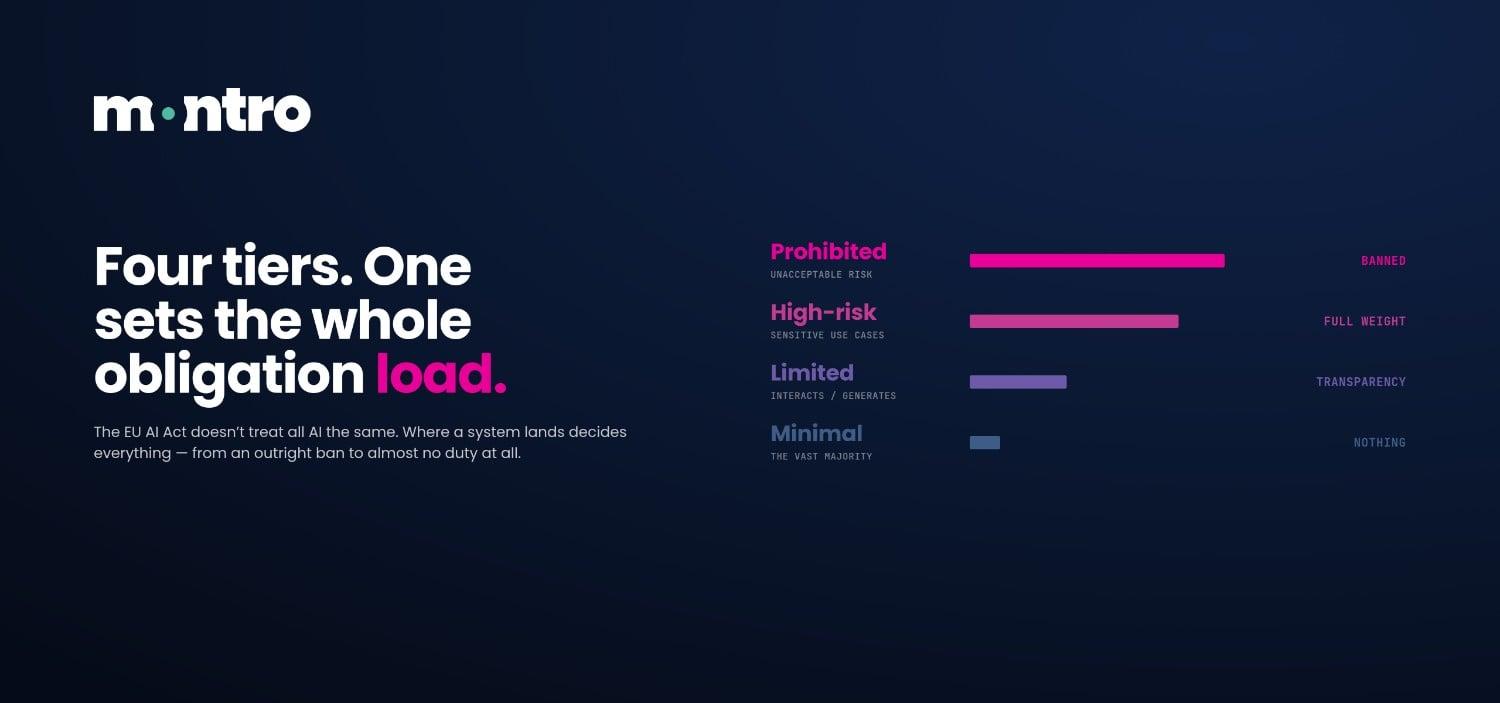
TL;DR: The EU AI Act does not regulate all AI the same way. It sorts AI systems into four risk tiers; prohibited, high, limited and minimal - and the tier decides everything that follows, from an outright ban at the top to almost no obligation at the bottom. Most of the Act's weight falls on the high-risk tier. Working out which tier a system falls into is the first compliance task, because every other obligation depends on it.
A spam filter and an automated hiring tool are both "using AI". One carries essentially no legal obligations; the other carries a great many. The difference is not the technology, it is what the system is used to decide, and how much that decision matters to a person.
That gap is the whole design of the EU AI Act: the more risk a system poses to people, the more it demands, and systems that pose little risk are left almost entirely alone.
That idea takes the shape of four tiers. Before an organisation can know what the Act requires of a given system, it has to know which tier the system sits in. The tier is not a label applied at the end; it is the decision everything else hangs on.
Prohibited: the AI you simply cannot deploy
At the top is a small set of practices the Act bans outright.
These are uses judged to carry unacceptable risk to people's rights and safety - things like social scoring by public authorities, manipulative systems designed to exploit vulnerabilities, and certain forms of biometric categorisation.
For most organisations this tier is straightforward: you are not doing these things, and if you are, the answer is not compliance but stopping. The value of knowing the tier exists is mostly to rule it out with confidence, and to recognise the handful of edge cases, certain uses of emotion recognition or biometric identification - where an organisation might be closer to the line than it assumes.
High-risk: where almost all the obligations live
Below the prohibited tier sits the high-risk category, and this is where the Act concentrates nearly all of its substantive requirements.
An AI system is high-risk in one of two ways. It is high-risk by use case if it falls into one of the areas the Act lists as sensitive - among them creditworthiness assessment, recruitment, essential services, education and certain law-enforcement uses. Or it is high-risk because it is a safety component of a product already regulated under EU product-safety law.
A hiring tool and a medical-device component reach the tier by different routes, but once there, they carry a demanding set of duties.
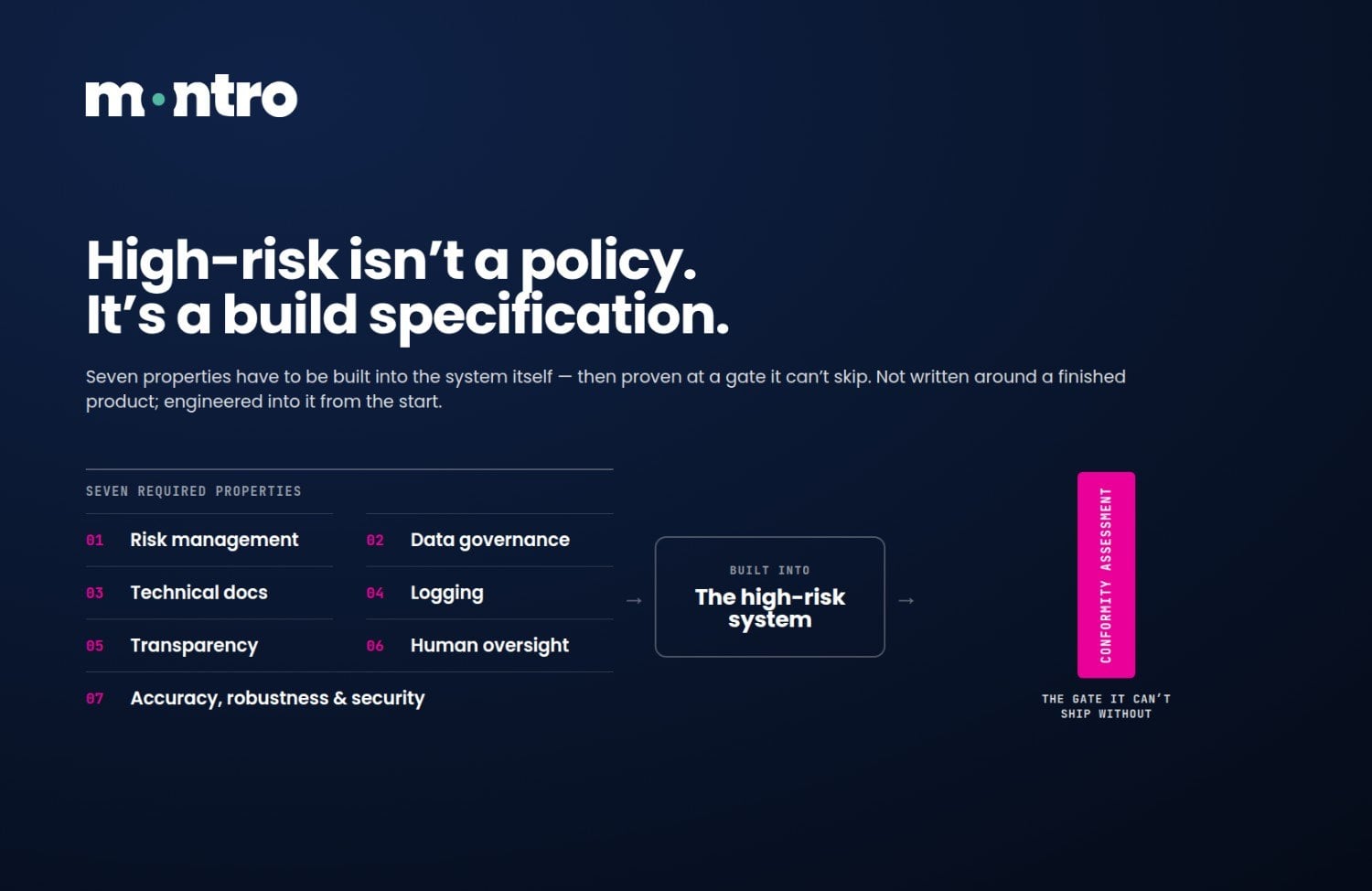
Those duties are the heart of the Act: a risk-management system, data governance, technical documentation, record-keeping, transparency to deployers, human oversight, and conformity assessment before the system goes to market.
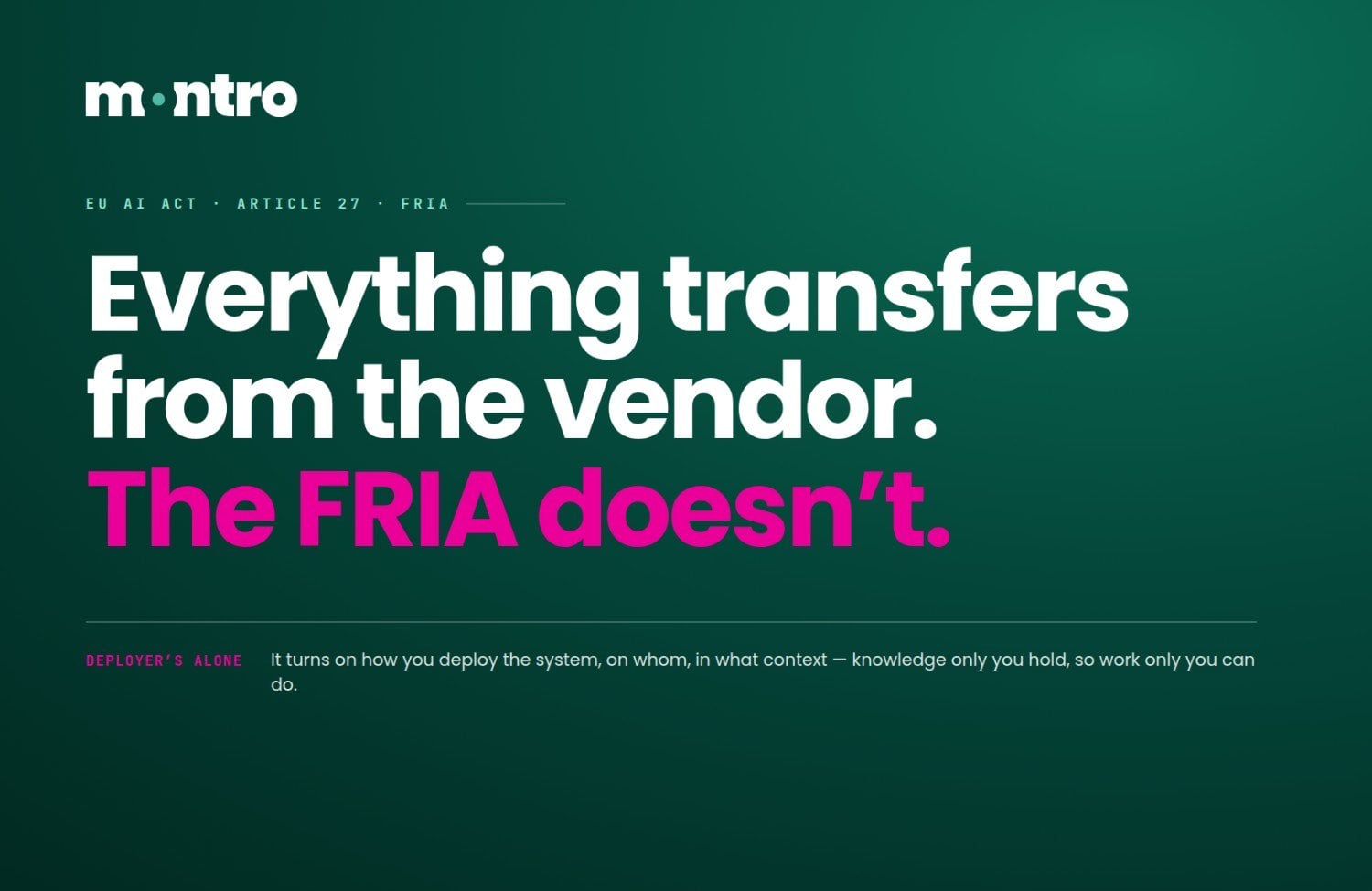
For certain high-risk deployments there is a further step, a Fundamental Rights Impact Assessment, carried out before the system is first used. If a system is high-risk, the compliance project is real. If it is not, most of this simply does not apply, which is why the classification matters so much.
Limited risk: tell people they are dealing with AI
The third tier is lighter, and it turns on a single principle: transparency.
Where an AI system interacts with people or generates content, the obligation is largely that people should know.
In practice this means a chatbot has to make clear that it is a machine, and synthetic media - AI-generated audio, images, video or text, has to be labelled as such. There is no conformity assessment here, no risk-management system, no documentation burden of the high-risk kind.
The duty is disclosure: not to hide that AI is involved. It is a meaningful obligation, but a narrow one, and it is where a large share of everyday generative-AI use lands.
Minimal risk: the vast majority, left alone
The fourth tier is the default, and it covers most AI in use today.
Spam filters, recommendation engines, AI in video games, inventory optimization - systems that pose little risk to people's rights carry no specific obligations under the Act at all.
This tier is worth naming precisely because it is so large. The AI Act is often described as sweeping, and for prohibited and high-risk systems it is. But the great majority of AI sits here, untouched by the Act's substantive requirements. Recognising that a system is minimal-risk is as useful as recognising that it is high-risk, it tells you where not to spend a compliance budget.
One thing the tiers don't cover: general-purpose AI
There is a piece the four-tier picture leaves out, and it is worth naming so the map is honest. General-purpose AI models, the large foundation models that other systems are built on top of - are not slotted into the four risk tiers.
They sit on a separate track of their own, with obligations around documentation, transparency and, for the most capable models, systemic-risk management.
For most organisations this matters as context rather than as a direct duty: you are far more likely to be a deployer building on a general-purpose model than the provider of one. But it is why "which of the four tiers is this" is not quite the whole classification question - for the model underneath, a different set of rules applies.
The tier is the switch
Put the four together and the design is clear: prohibited AI cannot be used, high-risk AI carries the full weight of the Act, limited-risk AI owes transparency, and minimal-risk AI owes essentially nothing. One system, placed once, and its entire obligation load is set by where it lands.
This is why classification is the first task, not a formality at the end. Get the tier right and the rest of the Act tells you what to do. Get it wrong - treat a high-risk hiring tool as limited-risk, or burden a minimal-risk system as though it were high-risk, and everything downstream is wrong with it.
And getting the tier wrong at the top is expensive. The fine for the most serious breaches reaches the higher of a fixed ceiling or a percentage of global turnover, set deliberately above the GDPR maximum.
The tiers are not the whole Act. But they are the map you read before anything else, and the single question - which tier is this system in, is the one every other obligation waits on.
Frequently asked questions
What are the four risk levels of the EU AI Act?
Montro's summary is: prohibited, high, limited and minimal. Prohibited AI practices are banned outright; high-risk systems carry the bulk of the Act's obligations, such as risk management, documentation and human oversight; limited-risk systems owe transparency, like disclosing that a user is dealing with AI; and minimal-risk systems, the large majority, carry no specific obligations.
The tier a system falls into determines everything the Act then requires of it.
What makes an AI system high-risk under the EU AI Act?
A system is high-risk in one of two ways: by use case, if it falls into a listed sensitive area such as creditworthiness assessment, recruitment, essential services or certain law-enforcement uses; or because it is a safety component of a product already regulated under EU product-safety law.
High-risk systems must meet the Act's core requirements before going to market, which is why correctly identifying the tier matters.
What are the transparency obligations under the EU AI Act?
For limited-risk systems, the obligation is that people should know they are dealing with AI.
AI that interacts directly with people has to disclose that it is AI, and AI-generated content - synthetic audio, images, video or text, has to be labelled as such. These duties are lighter than the high-risk regime; there is no conformity assessment or risk-management system, only disclosure.
Does the EU AI Act apply to all AI?
In scope, broadly yes; in substance, no. The Act reaches AI systems whose use or output touches the EU, but what it requires depends entirely on the risk tier. Most AI falls into the minimal-risk tier and carries no specific obligations, while the substantive requirements concentrate on the high-risk category. So the Act "applies" widely but demands little of the majority of systems, the weight falls where the risk to people is greatest.