There is a good reason financial firms automate their Record of Processing Activities. Maintained by hand, an Article 30 record goes stale the moment someone adds a tool or reroutes a data flow, and a stale RoPA is the one a regulator asks for on the worst possible day. Automation fixes the part that breaks most often: keeping the record current without a quarterly firefight.
But there is a catch specific to AI, and it is the reason a firm can automate its RoPA and still fail an audit. The automation is only as complete as what it can see, and the tools built to populate a RoPA were built to see SaaS, not AI.
What RoPA automation actually does well
Start with what works, because it is genuinely worth having. A RoPA automation platform connects to the systems a firm already runs - the SSO directory, the cloud environment, the email and the known SaaS estate, and watches them for change. When a new application appears or a data flow shifts, the record updates instead of drifting out of date.
This solves the real failure mode of the manual RoPA.
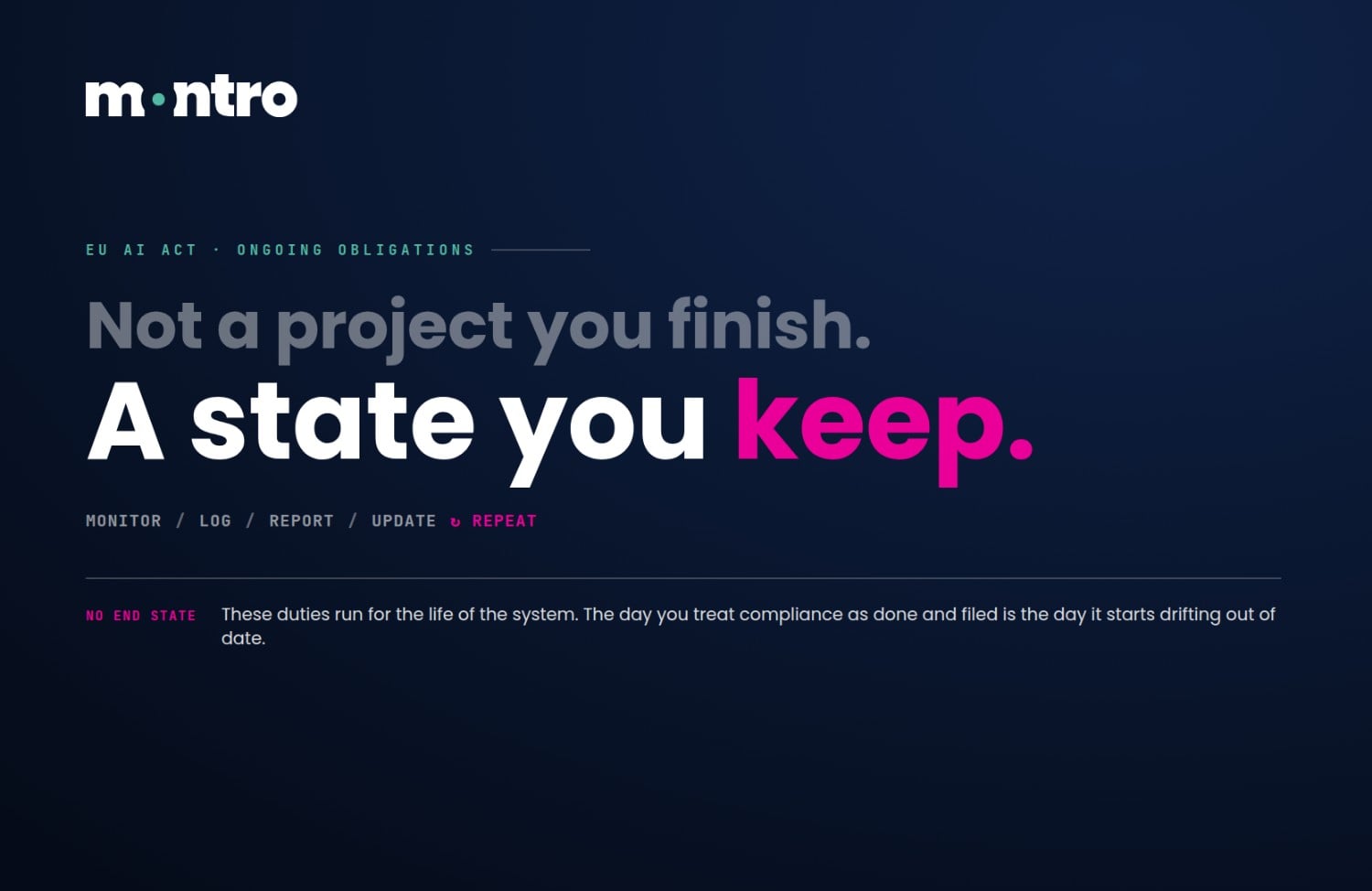
The problem was never writing the record once; it was keeping it true between reviews. Continuous monitoring turns a document that decayed the day after it was signed into one that reflects the estate as it changes. For a financial firm with dozens of systems and constant vendor churn, that is the difference between audit-ready and audit-scramble.
None of this is where firms come unstuck. The monitoring works. What decides whether it protects you is a quieter question: what it is pointed at.
Why AI tools slip past the scanners
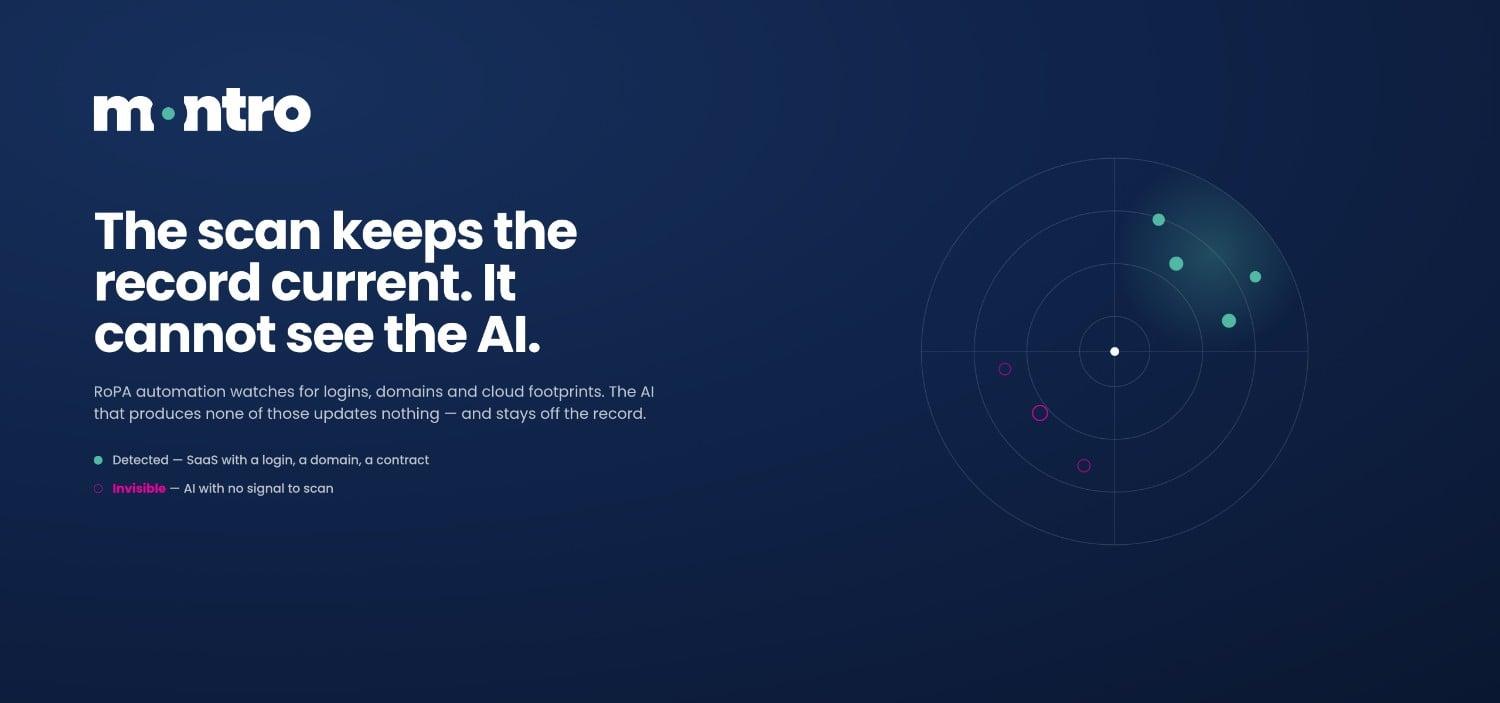
Here is the gap. The discovery underneath most RoPA automation was designed for a SaaS world, it finds applications by their logins, their cloud footprint, their network signatures, their cookies. That works because a SaaS application announces itself: it has a sign-in, a domain, a contract, a place in the directory.
Several platforms now advertise "AI discovery" too, and some of it is real. But most of that discovery still keys on the same SaaS-shaped signals, it finds the AI vendors you have contracts with, the AI products with their own logins. The question to ask is not whether a tool claims to find AI, but whether it can find the AI that produces no signal at all.
An AI tool often produces far weaker signals, or none of the ones the scanners key on. A model called from a spreadsheet macro may generate no new login. An AI feature switched on inside a platform the firm already licenses creates no new application to detect, the platform was already in the inventory; the feature that now processes data was not.
An internal automation built on an AI coding assistant may have no vendor, no domain and no SSO entry for a scanner to key on. The tool is doing real processing while producing none of the traces the record is built from.
Make it concrete. A credit-risk analyst wires a spreadsheet to an external model to score borrowers the main engine flags as borderline. It processes applicants' financial data every day, yet it has no login, no vendor record and no place in the SSO directory, nothing the scanner watches.
Each of these is a processing activity under Article 30 in its own right - it takes in personal data, does something to it, produces an output. But when it throws off none of the signals the scanners were built to catch, it never populates the automated record. The RoPA updates itself faithfully, and stays blind to exactly the processing most likely to be ungoverned.
Why this bites hardest in finance
A financial firm feels this gap more sharply than most, for two reasons.
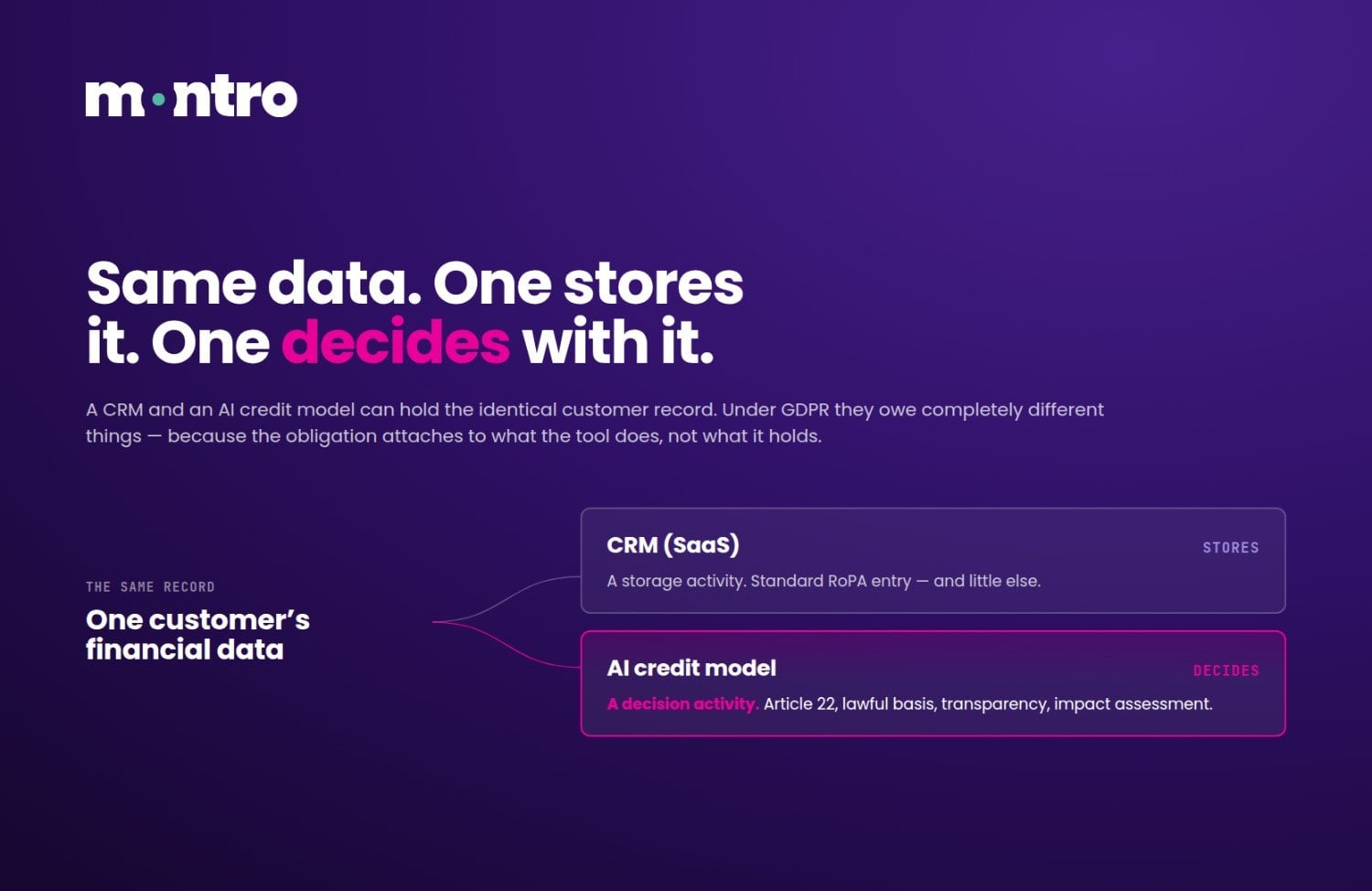
The first is the data. The AI tools appearing inside finance functions tend to touch precisely the data GDPR treats most seriously - transaction records, creditworthiness signals, customer financial profiles, sometimes special-category data.
A missing entry is not a trivial omission. An AI tool absent from the RoPA is not merely undocumented - it is almost certainly processing personal data with no lawful basis assessed, no retention decided and no security measure recorded.
That is a substantive breach of the data a regulator cares about most, not just a paperwork lapse.
The second is scrutiny. Financial entities are already among the most heavily supervised, and a RoPA, a supervisory authority can show to be incomplete undercuts the firm's whole accountability position. The record was supposed to prove the firm knows what it does with data; a demonstrable gap proves the opposite.
In a sector where the RoPA is likely to be tested, the AI blind spot is the part most likely to be found.
Automating the record, and the discovery beneath it
The fix is not to abandon automation. It is to make sure the discovery layer underneath it can actually see AI, not just SaaS.
That means discovery that finds AI tools by what they do rather than only by how they announce themselves - the embedded features, the internal automations, the models reached through existing applications, and then feeds each one into the record as its own Article 30 activity, with its purpose, its data categories, its recipients and its retention.
Automation of the record and discovery of the AI beneath it are two different capabilities, and a firm needs both. The first keeps the record current; the second decides whether it is complete. A platform strong on the first and blind on the second produces a confidently maintained account of a fraction of the estate.
I will be straight about the limit. Discovery can be automated, and maintenance can be automated, but the judgement in between - what a given AI tool is doing, whether it is a distinct processing activity, what its lawful basis and retention should be - is still work a person does.
Automation makes that judgement possible at the scale a real estate demands. It does not remove it. The goal is a RoPA that is both current and complete - and completeness, for AI, is the half the market quietly leaves out.
Frequently asked questions
Can you automate a GDPR RoPA?
Montro's position is that you can, and for any organisation of real size you should - but with a caveat. Automation continuously monitors the systems a firm runs and updates the Article 30 record as they change, which solves the staleness that makes most RoPAs non-compliant.
The caveat is that automation only records what its discovery layer can see; if that layer is tuned for SaaS, the AI tools processing data will be missing from an otherwise well-maintained record.
Why do standard RoPA tools miss AI tools?
Because they discover processing activities by the signals SaaS applications produce - logins, domains, cloud footprints, cookies - and many AI tools produce none of them. An AI feature enabled inside an existing platform, or a model called from a spreadsheet, creates no new application to detect, yet each is a processing activity under Article 30. The record updates without ever capturing them, which is why AI-aware discovery matters specifically.
Does automating a RoPA make a financial firm GDPR-compliant?
No. Automation keeps the record current and, if its discovery sees AI, more complete, but Article 30 compliance still depends on the record being accurate for every activity, and on human judgement about lawful basis, purpose and retention for each one. Automation supports that work at scale; it does not replace the judgement or guarantee completeness on its own.
What data do AI tools in finance typically process?
AI tools appearing in financial functions frequently handle transaction data, creditworthiness and risk signals, and customer financial profiles, and sometimes special-category data.
Because this is exactly the data GDPR treats most seriously, an AI processing activity missing from the RoPA is a more serious gap in finance than in many other sectors, which is why discovery completeness matters most here.