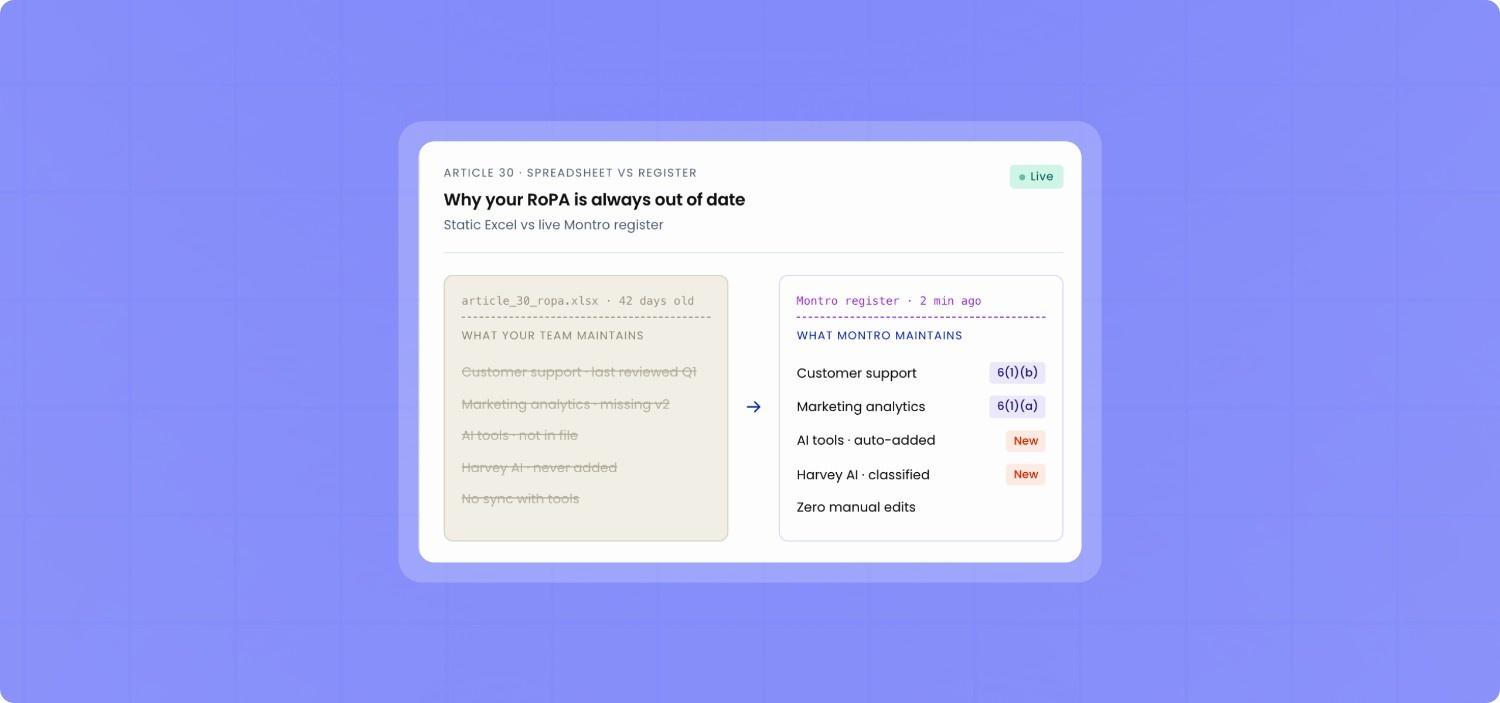
Spreadsheets fail at RoPA maintenance because they have no live connection to the systems where processing actually changes, no audit trail, no automated currency check, and no workflow for multi-function completion.
Your RoPA is a spreadsheet because the alternatives are too expensive, too heavy, or too unproven. Those are reasonable reasons. The four ways a spreadsheet fails when the supervisor asks for the register on Monday morning are not.
This piece is the structural diagnosis, what specifically breaks, beyond the generic argument that spreadsheets are out of date. It assumes the reader is a DPO who has heard the generic argument before and would like a more useful version.
The Four Failure Modes
Each compounds the next.
No source-of-truth integration. The spreadsheet has no live connection to the systems where processing activities actually change, the procurement system that adds new SaaS, the SSO that authenticates new tools, the expense system that catches paid subscriptions, the contract repository that tracks DPAs. Every change in the firm's processing posture has to be manually translated into a spreadsheet update by a human who hears about it. The information arrives late and incomplete. The register lags reality structurally, not because of effort.
No version control or audit trail. The spreadsheet records the current state. It does not record who changed which entry when, why, or against which evidence. When the supervisor asks for the register at a specific historic point in time, typically because an incident requires a backwards-looking review - the spreadsheet cannot produce it. The version history exists in the file's revision metadata if the firm uses a collaborative platform, but the metadata does not contain the reasoning. The audit trail the supervisor expects does not exist.
No automated currency check. The spreadsheet does not know it is out of date. There is no mechanism that tells the DPO "three SaaS tools have been adopted in the last quarter that are not on the register" or "two processing activities have material changes since their last review." The currency check is a manual operation the DPO must initiate, and the prompt to initiate it is typically the next audit, not the next material change.
No role-based completion logic. Article 30 entries require contributions from multiple functions. The legal team confirms the lawful basis. The data architect confirms the data categories. The security team confirms the technical safeguards. The DPO assembles and signs off. In a spreadsheet, all of this happens through email and meetings, with completion status visible only to the DPO. There is no workflow that escalates incomplete entries, surfaces blocking inputs, or produces auditable evidence that each contribution happened, and the absence of that workflow is the core compliance automation gap in spreadsheet-based RoPA maintenance.
Each failure mode would be tractable in isolation. Together they produce a register that is consistently behind, opaque to historic inspection, manually triggered, and held together by the DPO's institutional memory.
The supervisor request does not arrive with two weeks' notice. It arrives on a Tuesday, with a response window measured in days. The DPO who receives it knows immediately whether the register is up-to-date, not because they have checked it recently, but because they know when it was last updated manually and how much has changed since. The spreadsheet has the entries from three months ago. The processing activities added since then exist in a procurement approval, an expense claim, and an email thread that no one thought to include the privacy function in. The gap between what the register says and what the firm is actually doing is not a compliance failure in that moment. But it becomes one the moment the supervisor sees it. - Namita Razdan, Co-Founder, Montro |
When a Spreadsheet is Actually Sufficient
The honest qualifier. Spreadsheets are appropriate for some firms.
The conditions that make a spreadsheet RoPA workable: the firm has under fifty processing activities, the rate of change is low (no more than a handful of new processing activities per year), the SaaS environment is stable, the privacy function is one DPO with a clear deputy, and the regulatory exposure profile is moderate (not financial services, not health, not high-risk AI deployment). For a firm meeting all five conditions, a well-maintained spreadsheet is genuinely sufficient and the alternative tooling is over-investment.
The conditions are restrictive. Most European mid-market firms, particularly those operating any meaningful AI footprint, meet two or three at most. The four-failure-mode picture above describes what happens when a firm with the wrong conditions stays on a spreadsheet anyway.
What the Alternatives Offer
Two architectural directions resolve the four failure modes, with different cost profiles.
Documentation platforms - OneTrust, Securiti, BigID. Source of truth integration where the firm builds it; version control built in; currency tooling for entries the platform tracks; role-based workflow native. Designed for large enterprises with the configuration capacity to operate the depth. For mid-market firms, often over-scoped.
Inventory-driven automation - the architecture Montro represents and a small handful of newer tools. Source of truth integration with the systems that change processing activities continuously; version control and audit trail built into the inventory layer; currency tooling automatic; role-based completion enabled, with the judgement work (purposes, lawful bases) still requiring the DPO's input. Sized for mid-market firms; the operating model assumes the privacy function is one DPO with a couple of deputies, not a programme of six.
Both directions resolve the four failure modes. The choice depends on the firm's privacy programme depth, the regulatory surface, and the budget. The relevant comparison is not which tool is best but which tool is sized for the firm operating it, and which one treats RoPA currency as a compliance automation problem rather than a manual coordination one.
What the Supervisor Sees
Article 30(4) places an obligation on the controller and processor to make the register available to the supervisory authority on request. The implication is operational: the time from request to defensible production is itself part of what the supervisor is assessing. A register that takes two weeks to assemble from a spreadsheet, with manual cross-checks and follow-up clarifications, is responding to the request poorly even if the eventual content is accurate.
The Data Protection Commission, the CNIL, and BfDI have each signalled in inspection findings and Dear DPO communications that RoPA quality and currency are inspection focus areas. The pattern of findings is consistent: registers that were correct in the abstract but stale in operational detail; registers missing entries for processing activities the firm clearly conducts; registers where the historic state at the date of an incident could not be reconstructed.
The supervisor is not inspecting the spreadsheet. The supervisor is inspecting the register. The register fails when the underlying tooling cannot keep pace with the firm's actual processing posture, which is why RoPA maintenance is increasingly treated as a security governance infrastructure question, not a documentation one.
Frequently Asked Questions
Is a RoPA legally required under GDPR?
Yes. Article 30 requires controllers and processors to maintain a record of processing activities. The obligation applies to organisations with 250 or more employees, and to smaller organisations where processing is likely to result in a risk to data subjects' rights, is not occasional, or involves special categories of data.
What does a supervisory authority actually look for in a RoPA inspection?
Currency and completeness are the primary focus, not formatting. The DPC, CNIL, and BfDI have each signalled in inspection findings that the two patterns generating findings are registers missing entries for processing activities the organisation clearly conducts, and registers where the historic state at the date of an incident cannot be reconstructed.
How often should a RoPA be updated?
Article 30 does not specify an update frequency, it requires the register to reflect current processing activities. The register should be updated whenever a new processing activity begins, an existing one materially changes, or a processor relationship is added or removed. Annual review cycles are insufficient for organisations with active SaaS adoption.
What is the difference between a RoPA and a DPIA?
The RoPA under Article 30 is an inventory of all processing activities, what data is processed, for what purpose, by whom, and where. The DPIA under Article 35 is a risk assessment for specific high-risk processing activities. The RoPA identifies which activities may require a DPIA; the DPIA assesses the risk of those specific activities in detail.