EU AI governance programmes are being built on a foundation that does not exist yet. The inventory. Without knowing what AI is running in your organisation, every AI governance framework, every classification exercise, every documentation template is theoretical. Discovery has to come before all of it - and at most firms, it has not started.
“I’ve spent the last decade helping large organisations transform through technology, across enterprise software, telecoms, and AI-native startups. The pattern I see with AI governance right now is unsettling. Leaders are designing compliance frameworks for AI systems they haven’t yet found. The inventory problem isn’t a footnote, it is the whole problem.” - Ankur Arora, Co-founder, Montro
The Assumption Gap
IBM’s 2025 Cost of a Data Breach Report - based on 600 organisations globally and conducted by the Ponemon Institute - found that only 37% of organisations have any policy in place to manage AI or detect shadow AI use. Of those that do have governance policies, only 34% perform regular audits for unsanctioned AI tools. The other two-thirds are operating blind.
This is not a fringe problem. The 2024 Microsoft and LinkedIn Work Trend Index, which surveyed 31,000 people across 31 countries, found that 78% of AI users were bringing their own tools to work - tools that bypass procurement, skip security review, and carry no governance controls. An independent 2026 SaaS benchmark found that 26 of the top 50 shadow IT applications in enterprise environments are now pure-play AI tools. A 2024 Salesforce survey put the number of employees using unapproved AI tools at 55%. These tools are not passive - they request OAuth permissions, process sensitive data, and integrate into core workflows, often within hours of discovery by an enthusiastic employee.
The AI governance community has developed a detailed vocabulary for managing AI risk: risk tiers, transparency obligations, conformity assessments. But you cannot classify what you cannot see. You cannot document what you have not found. The entire edifice of AI compliance rests on an inventory that most enterprises do not have.
This is the assumption gap - and it is the reason governance-first approaches fail before they begin.
Why Compliance-First Fails
When the EU AI Act was published in the Official Journal in July 2024, most enterprise compliance functions responded predictably: they reached for documentation templates and risk questionnaires. It is an understandable instinct. The Act requires providers of high-risk AI systems to maintain a risk management system, establish data governance, produce technical documentation, enable record-keeping, and ensure human oversight - all enforced from August 2, 2026 for Annex III systems, with penalties reaching €15 million or 3% of global turnover for non-compliance, and up to €35 million or 7% of global turnover for prohibited practices.
Starting with the documentation, however, is like writing an insurance policy before knowing what you own. This is where compliance-first AI governance frameworks break down.
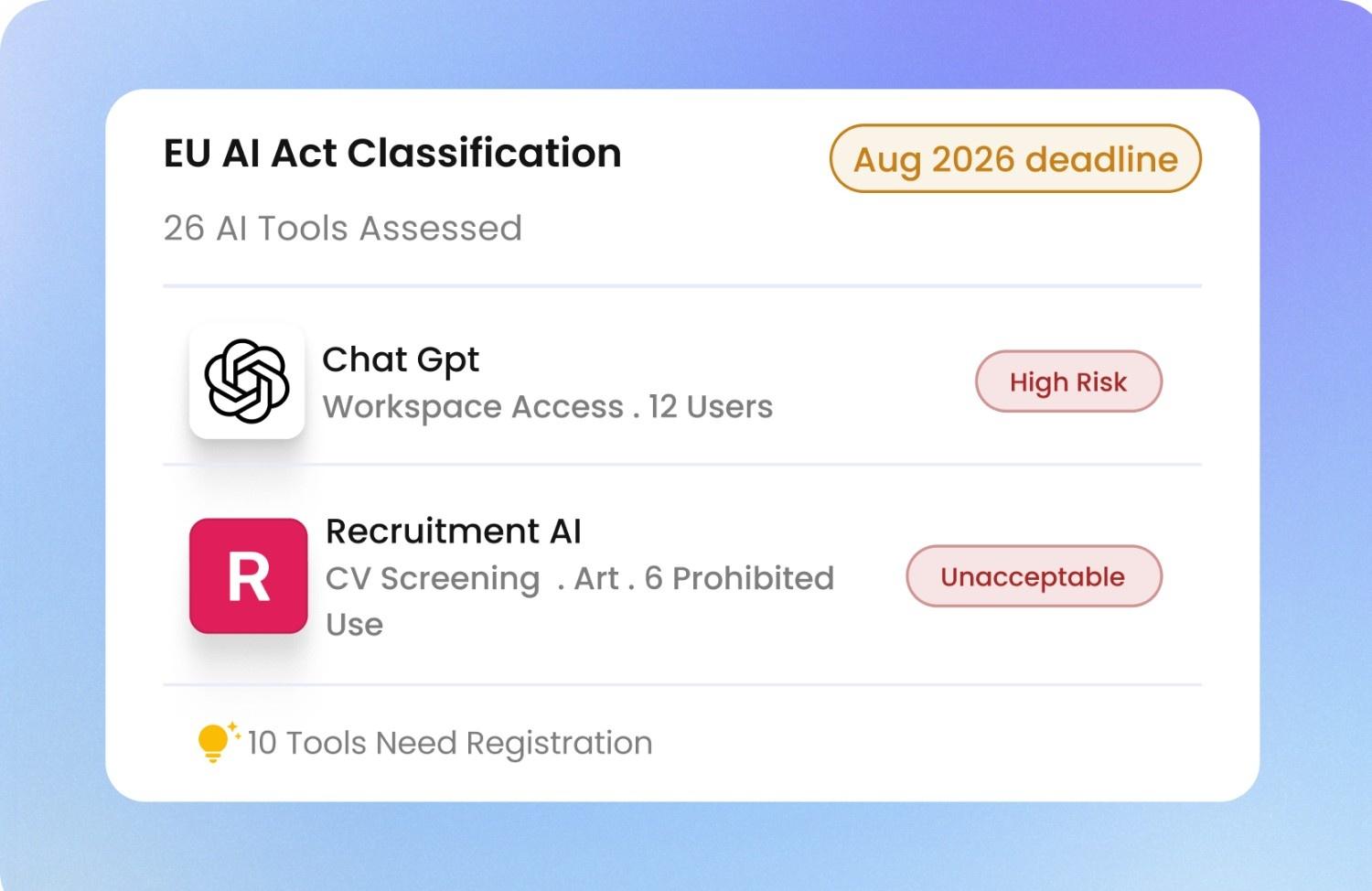
Analysis of organisational readiness shows that over half of enterprises lack systematic inventories of AI systems currently in production or development. Without knowing what AI exists within the enterprise, risk classification and compliance planning is impossible. A study of 106 enterprise AI systems found that 40% had unclear risk classifications - including systems in critical infrastructure, employment, and law enforcement categories that sit directly in Annex III’s crosshairs.
The Act’s requirement for a comprehensive AI system inventory is not incidental - it is architecturally foundational. PwC’s guidance on the Act explicitly identifies the AI inventory as the starting point for all further compliance decisions: inventory your AI use first, identify all projects and their status, and let this form the basis for everything else. Yet most governance programmes reverse this order, starting with frameworks and committees, and hoping the inventory problem resolves itself.
It does not resolve itself. IBM’s findings show that even among organisations with governance policies, less than half have formal approval processes for AI deployments. You cannot document what you have not found.
Compliance-first fails not because organisations lack commitment, but because documentation tools cannot discover. They are built to organise information you already have, not to find information you don’t know exists. This is the AI risk management gap that no framework resolves on its own.
Discovery-First in Practice
A discovery-first AI governance architecture begins not with a framework, but with a question: what AI is actually running in our environment right now?
Answering that question requires layered, parallel discovery methods - because no single method catches everything.
SSO and IdP Log Analysis
Surfaces AI tools that employees authenticate into with corporate credentials. It works well for widely adopted SaaS tools with proper SAML or OIDC integrations. It misses tools accessed via personal accounts, browser extensions, or direct API key usage - which are increasingly common.
OAuth Grant Scanning
Examines which third-party applications have been granted permissions to access corporate systems - calendars, email, documents. Many AI productivity tools acquire OAuth access silently, long before any IT review. The most widely adopted shadow AI tools rely heavily on OAuth-based permissions and instant integrations that connect directly to corporate data - then persist long after teams stop using them.
Financial and Expense Data Mining
Catches subscriptions appearing on corporate cards or expense reports - useful for identifying tools that have passed the trial stage and become embedded in workflows. It misses the substantial volume of tools adopted on free tiers, which in AI is the majority of initial adoption.
Email and Calendar Metadata Analysis
Flags vendor onboarding sequences, usage notifications, and billing communications from AI providers - a signal that a relationship with an AI vendor exists even when no formal procurement occurred.
Each method has blind spots. The architecture needs all four, cross-referenced, running continuously - not as a one-time audit, but as operational infrastructure. IBM’s data shows only 34% of organisations with governance policies audit for unsanctioned AI at all. That gap is not a compliance shortcoming; it is an infrastructure shortcoming. It requires continuous discovery as its response.
The Integration Gap
Here is the problem no enterprise AI governance programme is solving cleanly: discovery, classification, and documentation are treated as three separate workflows, run by three separate categories of tools, that do not talk to each other.
An organisation that takes discovery-first seriously will typically use a shadow IT or SaaS management platform to identify what AI tools exist. Once discovered, each tool must be classified under the EU AI Act’s risk tiers - a distinct analytical exercise requiring contextual judgement about the tool’s use case, the data it processes, and its decision-making role. That classification work happens in a different platform entirely. The resulting documentation - technical files, conformity assessments, fundamental rights impact assessments - is produced in yet another system, typically a GRC or privacy management tool.
The manual handoffs between these stages introduce exactly the errors and omissions that regulators will scrutinise, and they are the central AI compliance failure mode between now and August 2026. A tool discovered in January may not be classified until March, documented until June, and still contain stale information by the August enforcement deadline. There is no automated thread connecting discovery to classification to documentation, only spreadsheets, email threads, and the institutional memory of whoever is managing the programme that week.
What Montro Sees at the Integration Gap |
Most firms that reach out to Montro after starting their AI governance programme bring a discovery list with them. The list was produced three to six months ago, and it was accurate when it was made. The problem is that AI adoption does not pause between governance cycles: new tools are adopted, new AI features are activated inside existing tools, and new free-tier accounts are created. By the time the list reaches Montro, it is no longer complete. The gap between what the list shows and what is actually running is not the result of a failed programme; rather, it is the result of treating discovery as a one-time process rather than a continuous one. A snapshot taken once is not an inventory. It is a record of what existed on a specific day. |
Grant Thornton’s 2026 AI Impact Survey found that 78% of business executives lack strong confidence that they could pass an independent AI governance audit within 90 days. This is not a motivation gap. It is an architecture gap. The tooling required to connect discovery to classification to documentation in a single, auditable workflow simply does not yet exist in integrated form.
The organisations building genuine EU AI Act readiness are stitching together three separate tool categories, maintaining manual data pipelines between them, and accepting that their AI risk management posture is only as current as the last synchronisation. For a regulation with hard deadlines, personal liability provisions, and fines reaching 7% of global revenue, that is not good enough.
What the market needs, and what the next generation of enterprise AI governance platforms must deliver, is an architecture where discovery is the entry point for everything else. Where a tool first identified through an OAuth scan or expense report automatically enters a classification workflow, and a completed classification automatically populates the technical documentation template. A living inventory, not a periodic snapshot. AI compliance state that reflects what is actually deployed, not what was known at the last audit.
The EU AI Act enforcement deadline is not a documentation challenge. It is an infrastructure challenge. And infrastructure problems do not yield to documentation solutions.
Discovery is the infrastructure. Montro's free Discovery Audit finds every AI tool running in your environment, sanctioned or not - and gives you the inventory that every governance, classification, and documentation decision depends on. 30 days. No commitment.
Frequently Asked Questions
How long does a proper AI discovery exercise actually take?
The timeline depends more on the state of your own infrastructure than on the complexity of your AI landscape. A firm with mature identity infrastructure, accessible finance data, and browser monitoring configured and agreed can produce an initial inventory within thirty days. One relying on manual data extraction takes longer. What thirty days realistically gives you is a working inventory and initial classification - not a completed governance programme, but the point at which you can answer the board's question about what AI is running and what regulatory regimes it crosses.
What does ignoring the integration gap between discovery, classification, and documentation actually cost?
Your compliance posture is only as current as the last manual handoff between your tools. Where discovery, classification, and documentation are running as disconnected workflows, that gap is unlikely to close before the EU AI Act's August 2026 enforcement deadline. Under Article 99 of Regulation (EU) 2024/1689, organisations with high-risk AI systems not properly classified and documented by that date are exposed to AI compliance fine risk of up to €15 million or 3% of global turnover.
Where does an organisation start if it has nothing in place?
With the identity provider. Okta, Microsoft Entra ID, Google Workspace - whichever you use, holds a log of every AI tool employees authenticate into with corporate credentials. Running that analysis is a practical starting point and produces an initial inventory within days. It will miss free-tier tools and personal-account adoption entirely, but it gives you something concrete to work from immediately. The other discovery layers - financial data, email metadata, browser telemetry - layer on top and complete the picture progressively.