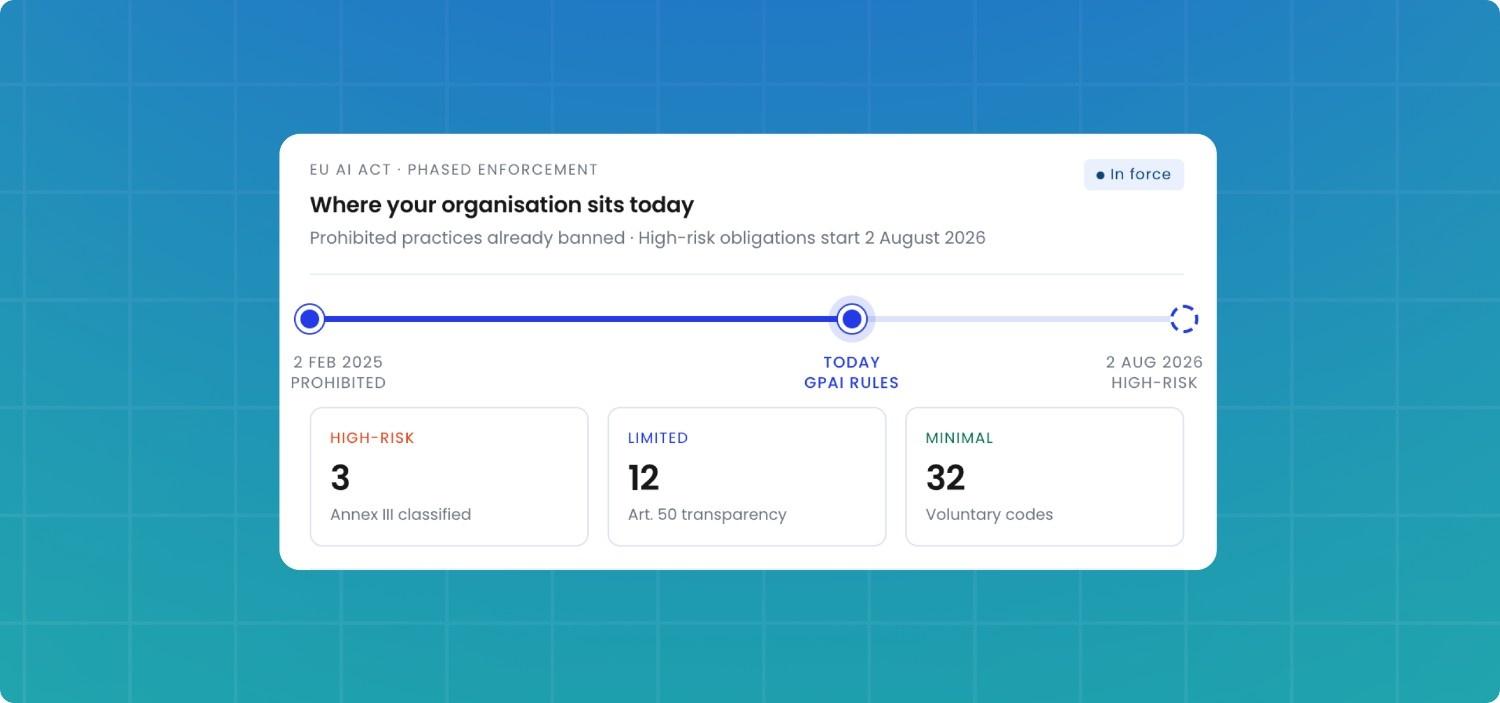
There is no single EU AI Act deadline. There are three. February 2025: prohibited practices became illegal. August 2026: high-risk system obligations apply. August 2027: existing high-risk systems already in production join the regime. The team that plans by phase will be ready. The team that plans by a single deadline will be late, and that check is the starting point of any honest AI risk classification exercise under the Act.
This piece is the structured timeline. What is binding now, what becomes binding in August 2026, what changes in August 2027, and what your DPO and CISO should be doing in each quarter between now and the main deadline. It assumes you have read the Act in summary; it does not re-explain the four risk tiers.
The Three Dates
The Act entered into force on 1 August 2024. Different chapters apply on different dates after that, set out in Article 113. Three dates carry most of the operational consequences.
2 February 2025 - already in force. Article 5 prohibited practices became enforceable. Article 4 AI literacy obligations became binding.
2 August 2026 - the main deadline. The bulk of high-risk system obligations apply. General-purpose AI model obligations apply. Article 50 transparency obligations apply. The penalty regime in Articles 99 to 101 applies. The notified bodies framework applies. Most of the Chapter III obligations that compliance teams have been preparing for take operational effect on this date.
2 August 2027 - the catch-up date. Existing high-risk AI systems already placed on the market or put into service before 2 August 2026 must be brought into compliance by this date. Public sector deployers operating high-risk AI systems get the same date for systems already in service.
2 February 2025 - What Is Already Binding
Two sets of obligations have been operationally enforceable for over a year, and most firms have done less on them than the obligations require.
Article 5 prohibited practices. The list covers AI systems deploying subliminal techniques or exploiting vulnerabilities in ways causing significant harm; social scoring by public or private actors producing detrimental treatment in unrelated contexts; real-time remote biometric identification in publicly accessible spaces by law enforcement, with narrow carve-outs; untargeted scraping of facial images from the internet or CCTV; emotion recognition in workplaces and educational institutions, with limited exceptions; biometric categorisation inferring race, political opinions, trade union membership, religious beliefs, sexual orientation, or sex life; and predictive policing based solely on profiling. The European Commission published Guidelines on prohibited AI practices on 4 February 2025, which clarify the scope of each category.
For most mid-market firms, the prohibited tier is straightforward to clear, either you are doing one of these things or you are not, and most are not. The trap sits in the workplace emotion-recognition prohibition, because some recruiting and customer-support AI tools include sentiment or emotion analysis that, depending on configuration, falls on the prohibited side of the line. Every HR and customer-support AI in the inventory needs to be checked specifically against this provision.
Article 4 AI literacy. Providers and deployers must ensure their staff and other persons dealing with AI systems on their behalf have a sufficient level of AI literacy, taking into account technical knowledge, experience, education, and the context in which the AI systems will be used.
Article 4 is the most overlooked obligation in the Act, because it is not a documentation obligation that produces a checkbox to tick. It is a competence obligation: the supervisor's reasonable expectation, on inspection, is that the people running AI systems can demonstrate they know what they are doing. A short structured AI literacy programme - induction module for general staff, role-specific training for high-risk AI users, refresh cadence, is sufficient evidence in most cases. The firms exposed are the ones treating Article 4 as a future obligation, and Article 4 exposure is the most common gap Montro finds when reviewing EU AI Act compliance readiness at European mid-market firms.
2 August 2026 - What Becomes Binding
The main deadline. Five clusters of obligations activate on this date.
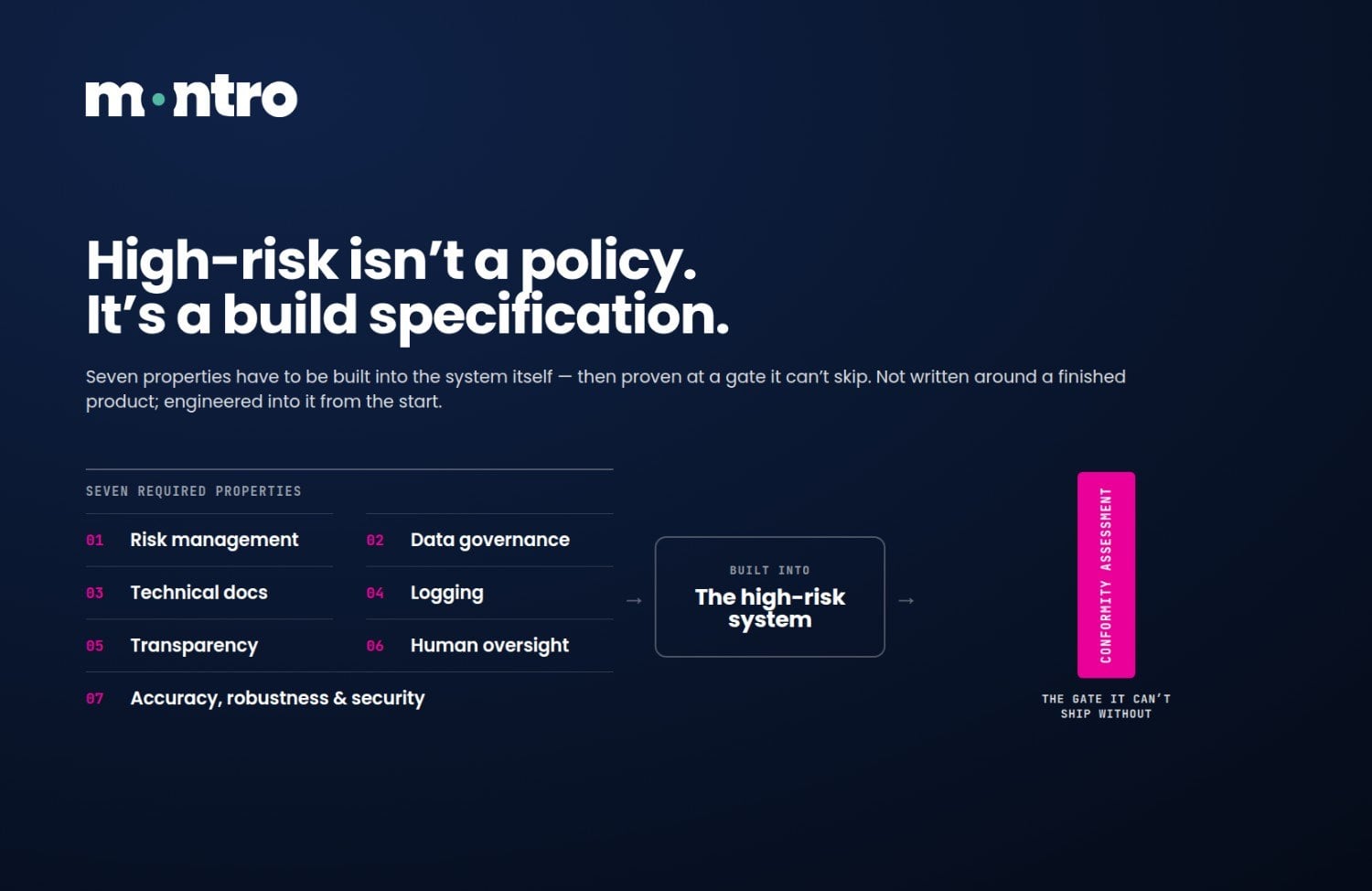
High-risk system obligations under Chapter III. The provider obligations - risk management system, technical documentation, conformity assessment, post-market monitoring, registration in the EU database, where applicable. The deployer obligations - using the system in line with the provider's instructions, ensuring human oversight, monitoring operation, informing affected workers before deployment, conducting fundamental rights impact assessments where applicable, maintaining logs, apply to every high-risk AI system in active use from this date, regardless of when it was procured.
General-purpose AI model obligations. The provider obligations on transparency, copyright compliance, and for models meeting the systemic-risk threshold the additional obligations on systemic risk assessment and mitigation. These provider obligations attach to the AI vendors - OpenAI, Anthropic, Google, the foundation model providers, not to the deployers using their APIs. Deployer obligations, for firms using GPAI through APIs, are at the AI system level for whatever they build with the API.
Article 50 transparency obligations. Chatbots must announce themselves as AI. AI-generated synthetic audio, image, video, or text must be labelled. Emotion recognition systems and biometric categorisation systems where not prohibited must inform the natural persons exposed. Deepfake content must be marked. The substantive obligations are lighter than the high-risk regime, but they apply to a much wider set of tools - every customer chatbot, every AI-generated marketing asset, every synthetic-voice agent.
The penalty regime in Articles 99 to 101. Up to €35 million or 7% of global annual turnover for prohibited-practices violations; up to €15 million or 3% for most other obligations; up to €7.5 million or 1.5% for supplying incorrect, incomplete, or misleading information to authorities.
The supervisor architecture. The AI Office, sitting within the European Commission's DG CNECT, coordinates Union-level enforcement. National competent authorities, designated by each member state - handle most operational supervision, with sectoral regulators continuing to enforce regulations they already enforce, increasingly incorporating AI risk explicitly.
2 August 2027 - What Changes for Existing Systems
The catch-up date matters for firms with long-deployed AI tools. The HR system that has been running CV screening since 2022 does not enforce on 2 August 2026, it enforces on 2 August 2027. The same applies to credit-scoring systems, customer-support AI deployed before mid-2026, biometric systems already operating.
The trap is that the firm needs to know which of those existing systems are high-risk in order to know which date applies. Discovery and classification have to happen anyway, and they have to happen before 2 August 2026, because the answer to which date applies depends on the answer to which tier the system sits in. The 2027 date is a grace period, not a separate planning track, and knowing which systems qualify for it requires completing AI risk classification across the full inventory before August 2026 anyway.
A Pattern Montro Sees Consistently |
When firms present their EU AI Act compliance roadmaps to Montro, the same misreading appears consistently. They divide their AI inventory into two lists - those that must be compliant by August 2026 and those that can afford to wait until August 2027. The logic seems reasonable until you ask how the second list was produced. And in most cases the answer is that someone made a judgement call without completing the classification process. The 2027 date is not a separate planning track. It is a grace period for systems that have already been discovered and classified as high-risk systems already in operation. To know which systems qualify for it, the full discovery and classification work has to be done before August 2026 anyway. The firms that see 2027 as extra time to get prepared have, in most cases, never done the work that would tell them whether they need it. |
A Quarter-By-Quarter Plan From Now to August 2026
The structured way to sequence the work, working backwards from the August 2026 deadline.
Q2 2026 - discovery and classification. The complete AI inventory. The four-tier AI risk classification - prohibited, high-risk, limited-risk, minimal-risk, applied honestly across the inventory. The deployer-versus-provider determination per system. The Annex III category assignment for high-risk AI systems. The Article 4 AI literacy programme designed and rolled out.
Q3 2026docume - ntation and controls. For each high-risk system, the deployer documentation: instructions-for-use confirmation, human oversight role assignment, monitoring procedures, log retention configuration, fundamental rights impact assessment where applicable. For each Article 50 system, the transparency implementation - chatbot announcements, generated-content labelling, synthetic-voice disclosure.
Q4 2026 - operational running. The first quarter of operation under the new regime. Incident response process tested through tabletop exercises. The supervisor relationship engaged through any required notifications. Continuous monitoring of the inventory as new AI features turn on inside SaaS the firm already uses. Internal audit of the Q3 documentation against actual practice.
The plan looks unhurried because it is. The work is largely operational, not analytical. The teams that struggle are the ones that arrive at Q3 2026 still clarifying what tools they have.
Common Planning Errors
Five patterns we see in audits and that compliance leads should pre-empt.
Treating the Act as a single August 2026 deadline. The phased structure changes the planning architecture. February 2025 obligations have been live for over a year; the firm's prohibited-practices position and AI literacy programme should already exist.
Underweighting Article 4. The most common single oversight. Article 4 is real and binding now.
Ignoring General Purpose AI obligations on the assumption they are someone else's problem. The provider obligations are someone else's. The deployer obligations for what your firm builds on top of GPAI are yours.
Treating Article 50 as a low priority because the obligations are lighter. The obligations apply to a wider set of tools than the high-risk regime, and the implementation work - chatbot announcements, content labelling, voice disclosure - is fiddly enough that it cannot be done at the last minute across a large surface.
Planning for the Act in isolation from GDPR, DORA, and NIS2. The same AI tool typically generates obligations under three or four regimes. This is where AI governance programme design matters most, the compliance work converges at the operational substrate; building four parallel pipelines burns through budget on duplicated work.
Frequently Asked Questions
Does the EU AI Act apply to companies outside the EU?
Yes. The Act has extraterritorial reach; it applies to providers placing AI systems on the EU market and deployers using AI systems within the EU, regardless of where those organisations are headquartered. A US firm whose AI tool is used by EU employees or customers is in scope.
What is the AI Office under the EU AI Act?
The AI Office sits within the European Commission's DG CNECT and coordinates Union-level enforcement of the Act. It oversees general-purpose AI model obligations directly and works alongside national competent authorities who handle most operational supervision at member state level.
What triggers a Fundamental Rights Impact Assessment under the EU AI Act?
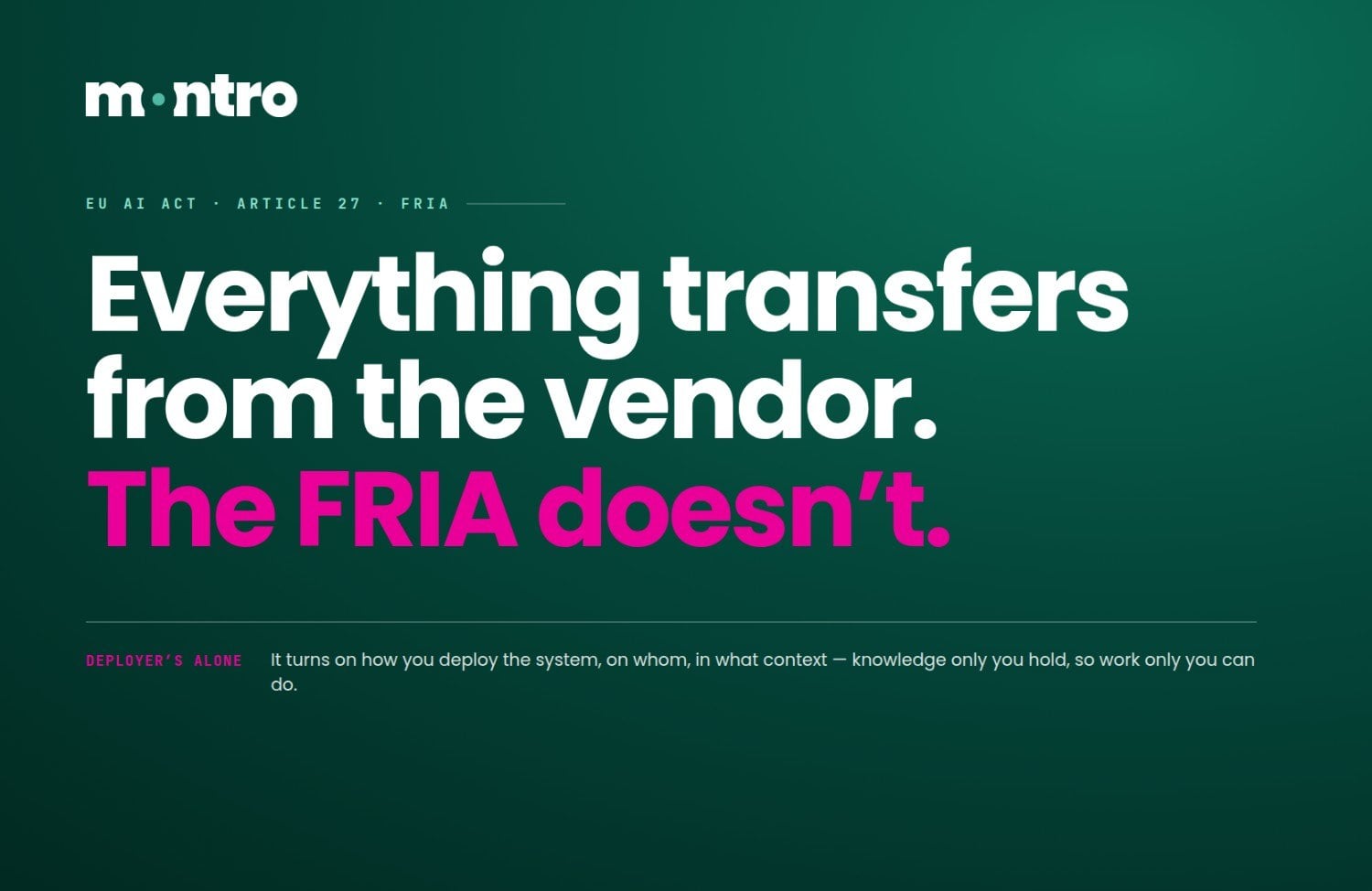
Deployers of high-risk AI systems in certain contexts, public authorities, private bodies providing public services, and deployers of systems listed in specific Annex III categories, must conduct a Fundamental Rights Impact Assessment before putting the system into use. It assesses the system's potential impact on rights beyond data protection, including non-discrimination, access to justice, and dignity.
What happens if a firm discovers a prohibited AI practice already in use?
Article 5 obligations have been enforceable since February 2025. A firm that identifies a prohibited practice already in operation faces immediate exposure, the obligation is to cease use, not to remediate. The practical priority is inventory and AI risk classification to surface any tools that may fall on the prohibited side of the line before a supervisor finds them first.